Loading Wolfram cloud notebook need s few seconds, take a break maybe?
Copyright of the code belongs to the owner of this site, the codes are completely open-source, use it as you like.
作者: Finn
本文演示从静态球对称时空推导TOV方程
预备知识:Schutz或MTW track1级别的相对论知识储备(甚至不需要)
0.1.1 Metric of Static Spherically Symmetric Stars
The metric of spherically symmetric spacetime is:
$$
\mathrm{d} s^2=g_{00} \mathrm{~d} t^2+2 g_{0 r} \mathrm{~d} r \mathrm{~d} t+g_{r r} \mathrm{~d} r^2+r^2 \mathrm{~d} \Omega^2
\tag{1.1}$$
We define a static spacetime to be one in which we can find a time coordinate $t$ with two properties: (i) all metric components are independent of $t$, and (ii) the geometry is unchanged by time reversal, $t \rightarrow-t$. (A spacetime with property (i) but not necessarily (ii) is said to be stationary.)
Condition (ii) has the following implication. The coordinate transformation $(t, r, \theta, \phi) \rightarrow$ $(-t, r, \theta, \phi)$ has $\Lambda^{\overline{0}}{ }_0=-1, \Lambda_j^i=\delta_j^i$, and we find:
$$
\left.g_{\bar{0} \bar{0}}=\left(\Lambda^0_{\bar{0}}\right)^2g_{00}=g_{00} \right.\
$$
$$
g_{\bar{0} \bar{r}}=\Lambda_{\bar{0}}^0 \Lambda^r_{\bar{r}} g_{0 r}=-g_{0 r}\
$$
$$
g_{\bar{r} \bar{r}}=\left(\Lambda^r {\bar{r}}\right)^2 g{r r}=g_{r r}
\tag{1.2}$$
by assuming $g_{00}<0$ and $g_{rr}>0$ $($ we shall see these conditions do hold inside stars $)$, denote: $g_{00}=-e^{2\phi}$ and $g_{rr}=e^{2\lambda}$
then solve Eq.$(1.2)$ for the metric of static spherically symmetric spacetime:
$$
\mathrm{d} s^2=-\mathrm{e}^{2 \Phi} \mathrm{d} t^2+\mathrm{e}^{2 \Lambda} \mathrm{d} r^2+r^2 d \Omega^2
\tag{1.3}$$
0.1.2 Einstein Tensors
We can show that for the metric given by Eq. $(1.3)$, the Einstein tensor has components:
$$
\begin{aligned}
&G_{00}=\frac{1}{r^2} \mathrm{e}^{2 \Phi} \frac{\mathrm{d}}{\mathrm{d} r}\left[r\left(1-\mathrm{e}^{-2 \Lambda}\right)\right] \\
&G_{r r}=-\frac{1}{r^2} \mathrm{e}^{2 \Lambda}\left(1-\mathrm{e}^{-2 \Lambda}\right)+\frac{2}{r} \Phi^{\prime} \\
&G_{\theta \theta}=r^2 \mathrm{e}^{-2 \Lambda}\left[\Phi^{\prime \prime}+\left(\Phi^{\prime}\right)^2+\Phi^{\prime} / r-\Phi^{\prime} \Lambda^{\prime}-\Lambda^{\prime} / r\right] \\
&G_{\phi \phi}=\sin ^2 \theta G_{\theta \theta}
\end{aligned}
\tag{1.4}$$
where $\Phi^{\prime}:=\mathrm{d} \Phi / \mathrm{d} r$, etc. All other components vanish.
0.1.3 Structure Equations
In this subsection we derive Tolman-Oppenheimer-Volkof equation from the $r$ component of conservation law along with the $(r,r)$ component of \textit{Einstein field equation}, and then an auxiliary equation from the $(t,t)$ component of Einstein field equation, and end with an introduction on the equation of state EoS
The stress-energy tensor of perfect fluid is given by:
$$
T^{\alpha \beta}=(\rho+p) U^\alpha U^\beta+p \eta^{\alpha \beta}
\tag{1.5}$$
alongs with the conservation law: $T^{\alpha \beta}_{; \beta}=0$, of which the $r$ component gives:
$$
(\rho+p) \frac{\mathrm{d} \Phi}{\mathrm{d} r}=-\frac{d p}{\mathrm{~d} r}
\tag{1.6}$$
Einstein field equation states: $G^{\alpha \beta}=8 \pi T^{\alpha \beta}$, by denoting: $m(r):=\frac{1}{2} r\left(1-\mathrm{e}^{-2 \Lambda}\right)$ and substitute Einstein tensors by eq$(1.4)$, the $(r,r)$ component of field equation reads:
$$
\frac{\mathrm{d} \Phi}{\mathrm{d} r}=\frac{m(r)+4 \pi r^3 p}{r[r-2 m(r)]}
\tag{1.7}$$
Now by combing Eq$(1.6)$ and Eq$(1.7)$, we can eliminate $\Phi$ and obtain:
$$
\frac{\mathrm{d} p}{\mathrm{~d} r}=-\frac{(\rho+p)\left(m+4 \pi r^3 p\right)}{r(r-2 m)}
\tag{1.8}$$
known as the Tolman-Oppenheimer-Volkov equation
In addition to Eq$(1.7)$, the $(t,t)$ component of Einstein field equation gives another structure equation:
$$
\frac{\mathrm{d} m(r)}{\mathrm{d} r}=4 \pi r^2 \rho
\tag{1.9}$$ where again we have denoted $g_{rr}$ by $\left(1-\frac{2 m(r)}{r}\right)^{-1}$.
To complete the struction equations requires a relation between energy density $\rho$ and pressure $p$, called the Equation of State (EoS):
$$
\rho = \rho(p)
\tag{1.10}$$
0.1.4 Boundary Conditions and General Solving Procedure
To solve for $m(r)$ and $p(r)$ from TOV equation Eq$(1.8)$ and auxiliary equation Eq$(1.9)$ along with EoS Eq$(1.10)$, we need two boundary conditions:
The first boundary on $m$ given by properties of spacetime, we state without a proof$($check Schutz if you want$)$:
$$
m(r=0)=0
\tag{1.11}$$
while the second arbitrarily chosen:
$$
p(r=0)=p_c
\tag{1.12}$$
STEP1: with these two boundary conditions providing two integral constants, we can obtain expressions for $m=m(r)$ and $p=p(r)$ simply by integration
STEP2: with condition $p(R)=0$ and expression obtained in STEP1, obtaining $R$; then obtain $M$ by $M=m(R)$
STEP3: to solve for $\Phi(r)$ from Eq$(1.6)$, which need another boundary condition on $\phi$, this can be obtained from continuity condition and Schwarzschild exterior metric which yields $g_{00}(r=R)=-\left(1-\frac{2 M}{R}\right)$, substitute $M$ and $R$ gives the boundary condition on $g_{00}(r=0)$, or equivalently, $\Phi(r=0)$
Derive relativistic structure equation (TOV equation) from static spherically symmetric spacetime
prerequisites: GR at the level of Schutz’s textbook or track1 of MTW
0.1.1 Metric of Static Spherically Symmetric Stars
The metric of spherically symmetric spacetime is:
$$
\mathrm{d} s^2=g_{00} \mathrm{~d} t^2+2 g_{0 r} \mathrm{~d} r \mathrm{~d} t+g_{r r} \mathrm{~d} r^2+r^2 \mathrm{~d} \Omega^2
\tag{1.1}$$
We define a static spacetime to be one in which we can find a time coordinate $t$ with two properties: (i) all metric components are independent of $t$, and (ii) the geometry is unchanged by time reversal, $t \rightarrow-t$. (A spacetime with property (i) but not necessarily (ii) is said to be stationary.)
Condition (ii) has the following implication. The coordinate transformation $(t, r, \theta, \phi) \rightarrow$ $(-t, r, \theta, \phi)$ has $\Lambda^{\overline{0}}{ }_0=-1, \Lambda_j^i=\delta_j^i$, and we find:
$$
\left.g_{\bar{0} \bar{0}}=\left(\Lambda^0_{\bar{0}}\right)^2g_{00}=g_{00} \right.\
$$
$$
g_{\bar{0} \bar{r}}=\Lambda_{\bar{0}}^0 \Lambda^r_{\bar{r}} g_{0 r}=-g_{0 r}\
$$
$$
g_{\bar{r} \bar{r}}=\left(\Lambda^r {\bar{r}}\right)^2 g{r r}=g_{r r}
\tag{1.2}$$
by assuming $g_{00}<0$ and $g_{rr}>0$ $($ we shall see these conditions do hold inside stars $)$, denote: $g_{00}=-e^{2\phi}$ and $g_{rr}=e^{2\lambda}$
then solve Eq.$(1.2)$ for the metric of static spherically symmetric spacetime:
$$
\mathrm{d} s^2=-\mathrm{e}^{2 \Phi} \mathrm{d} t^2+\mathrm{e}^{2 \Lambda} \mathrm{d} r^2+r^2 d \Omega^2
\tag{1.3}$$
0.1.2 Einstein Tensors
We can show that for the metric given by Eq. $(1.3)$, the Einstein tensor has components:
$$
\begin{aligned}
&G_{00}=\frac{1}{r^2} \mathrm{e}^{2 \Phi} \frac{\mathrm{d}}{\mathrm{d} r}\left[r\left(1-\mathrm{e}^{-2 \Lambda}\right)\right] \\
&G_{r r}=-\frac{1}{r^2} \mathrm{e}^{2 \Lambda}\left(1-\mathrm{e}^{-2 \Lambda}\right)+\frac{2}{r} \Phi^{\prime} \\
&G_{\theta \theta}=r^2 \mathrm{e}^{-2 \Lambda}\left[\Phi^{\prime \prime}+\left(\Phi^{\prime}\right)^2+\Phi^{\prime} / r-\Phi^{\prime} \Lambda^{\prime}-\Lambda^{\prime} / r\right] \\
&G_{\phi \phi}=\sin ^2 \theta G_{\theta \theta}
\end{aligned}
\tag{1.4}$$
where $\Phi^{\prime}:=\mathrm{d} \Phi / \mathrm{d} r$, etc. All other components vanish.
0.1.3 Structure Equations
In this subsection we derive Tolman-Oppenheimer-Volkof equation from the $r$ component of conservation law along with the $(r,r)$ component of \textit{Einstein field equation}, and then an auxiliary equation from the $(t,t)$ component of Einstein field equation, and end with an introduction on the equation of state EoS
The stress-energy tensor of perfect fluid is given by:
$$
T^{\alpha \beta}=(\rho+p) U^\alpha U^\beta+p \eta^{\alpha \beta}
\tag{1.5}$$
alongs with the conservation law: $T^{\alpha \beta}_{; \beta}=0$, of which the $r$ component gives:
$$
(\rho+p) \frac{\mathrm{d} \Phi}{\mathrm{d} r}=-\frac{d p}{\mathrm{~d} r}
\tag{1.6}$$
Einstein field equation states: $G^{\alpha \beta}=8 \pi T^{\alpha \beta}$, by denoting: $m(r):=\frac{1}{2} r\left(1-\mathrm{e}^{-2 \Lambda}\right)$ and substitute Einstein tensors by eq$(1.4)$, the $(r,r)$ component of field equation reads:
$$
\frac{\mathrm{d} \Phi}{\mathrm{d} r}=\frac{m(r)+4 \pi r^3 p}{r[r-2 m(r)]}
\tag{1.7}$$
Now by combing Eq$(1.6)$ and Eq$(1.7)$, we can eliminate $\Phi$ and obtain:
$$
\frac{\mathrm{d} p}{\mathrm{~d} r}=-\frac{(\rho+p)\left(m+4 \pi r^3 p\right)}{r(r-2 m)}
\tag{1.8}$$
known as the \textbf{\textit{Tolman-Oppenheimer-Volkov equation}}
In addition to Eq$(1.7)$, the $(t,t)$ component of Einstein field equation gives another structure equation:
$$
\frac{\mathrm{d} m(r)}{\mathrm{d} r}=4 \pi r^2 \rho
\tag{1.9}$$ where again we have denoted $g_{rr}$ by $\left(1-\frac{2 m(r)}{r}\right)^{-1}$.
To complete the struction equations requires a relation between energy density $\rho$ and pressure $p$, called the Equation of State (EoS):
$$
\rho = \rho(p)
\tag{1.10}$$
0.1.4 Boundary Conditions and General Solving Procedure
To solve for $m(r)$ and $p(r)$ from TOV equation Eq$(1.8)$ and auxiliary equation Eq$(1.9)$ along with EoS Eq$(1.10)$, we need two boundary conditions:
The first boundary on $m$ given by properties of spacetime, we state without a proof$($check Schutz if you want$)$:
$$
m(r=0)=0
\tag{1.11}$$
while the second arbitrarily chosen:
$$
p(r=0)=p_c
\tag{1.12}$$
STEP1: with these two boundary conditions providing two integral constants, we can obtain expressions for $m=m(r)$ and $p=p(r)$ simply by integration
STEP2: with condition $p(R)=0$ and expression obtained in STEP1, obtaining $R$; then obtain $M$ by $M=m(R)$
STEP3: to solve for $\Phi(r)$ from Eq$(1.6)$, which need another boundary condition on $\phi$, this can be obtained from continuity condition and Schwarzschild exterior metric which yields $g_{00}(r=R)=-\left(1-\frac{2 M}{R}\right)$, substitute $M$ and $R$ gives the boundary condition on $g_{00}(r=0)$, or equivalently, $\Phi(r=0)$
STEP4: the final step is to solve for $\Phi(r)$ from conservation law Eq$(1.6$ with boundary condition from STEP3
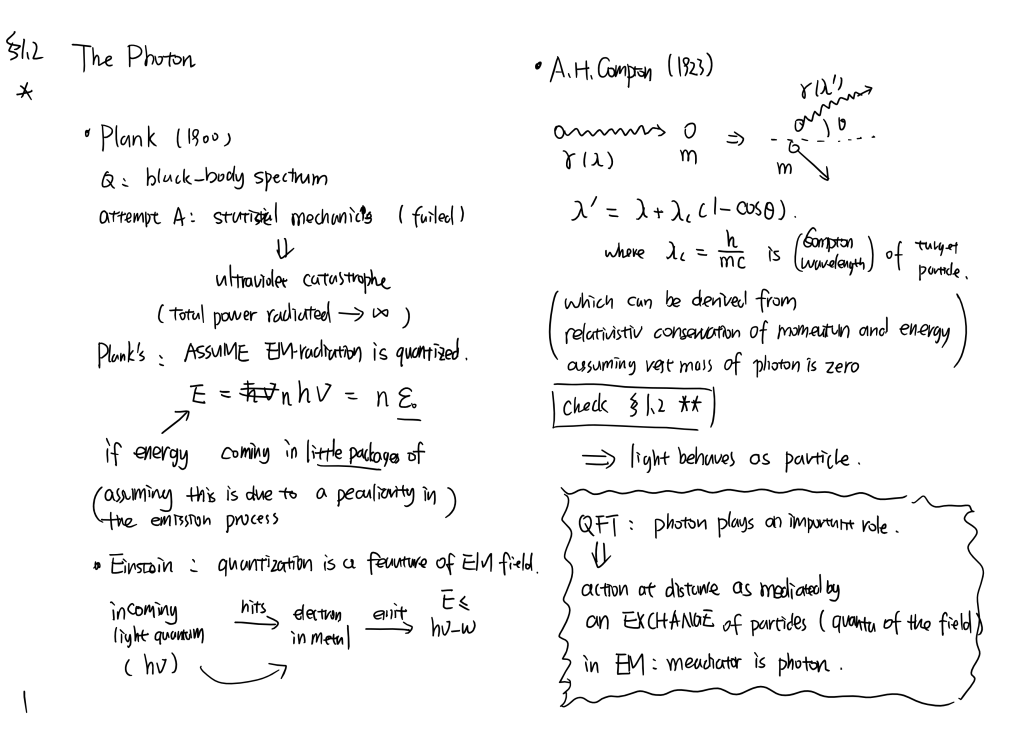
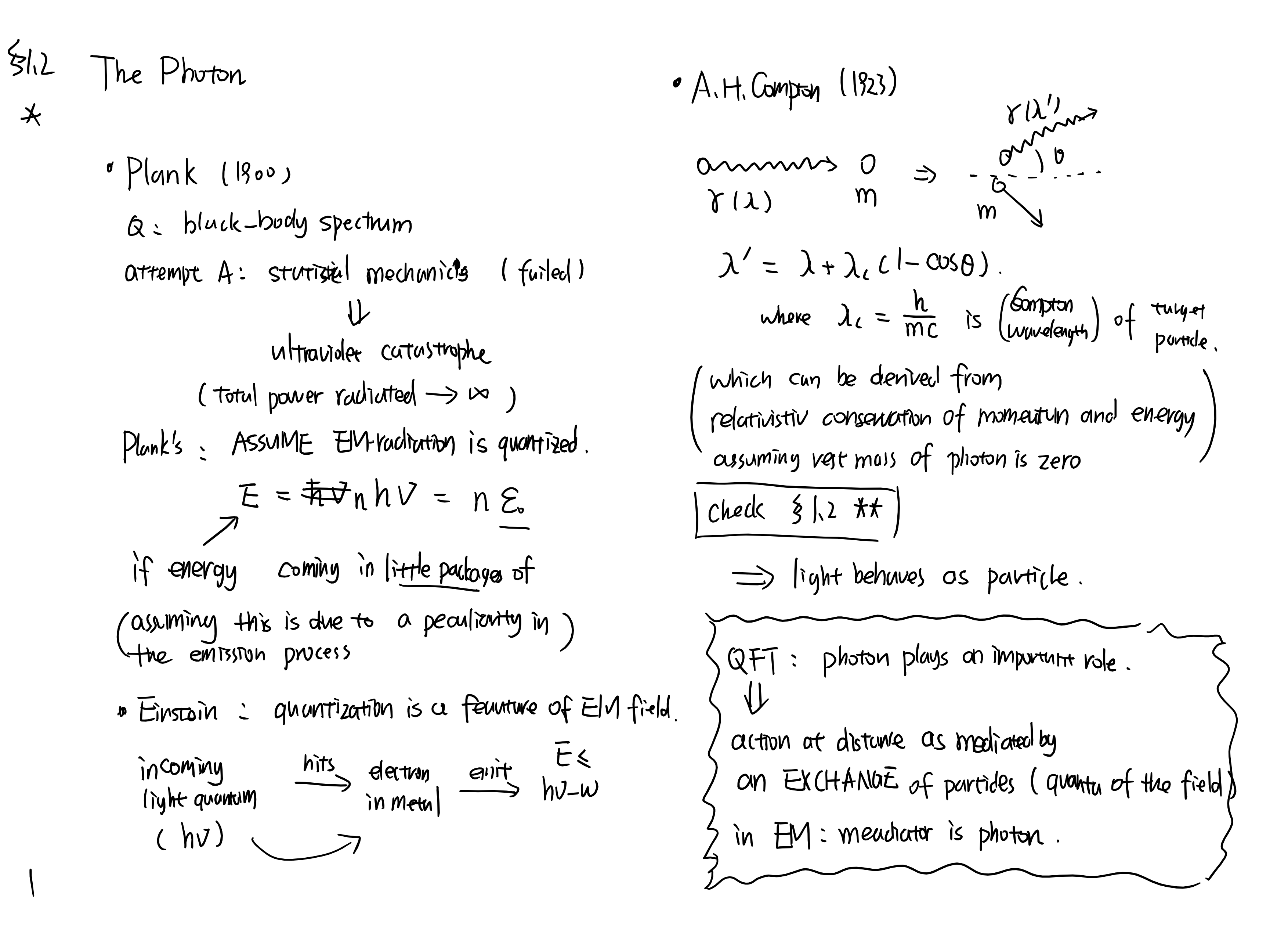
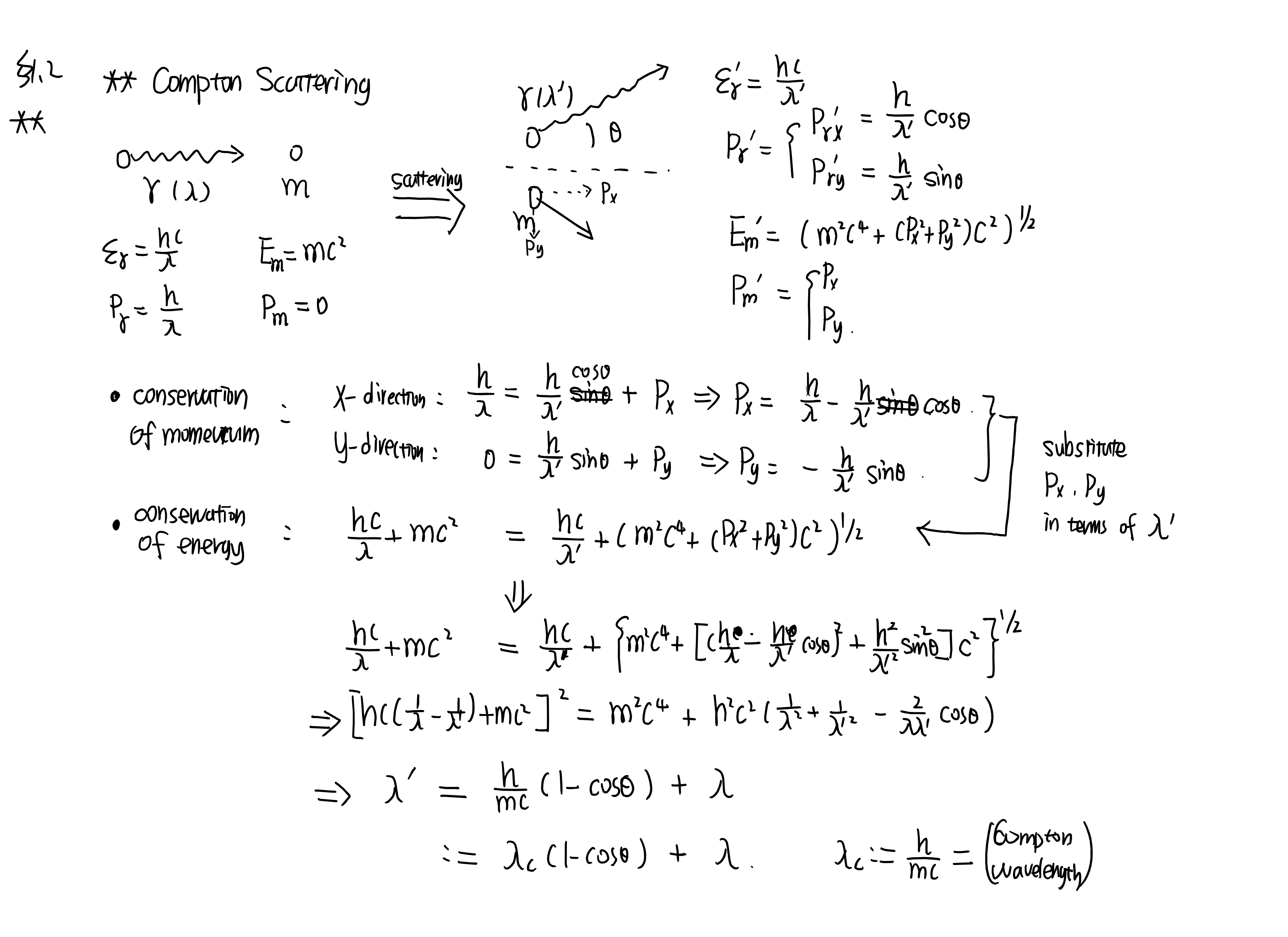
1.2 Photon
康普顿散射的计算可以作为相对论的入门习题
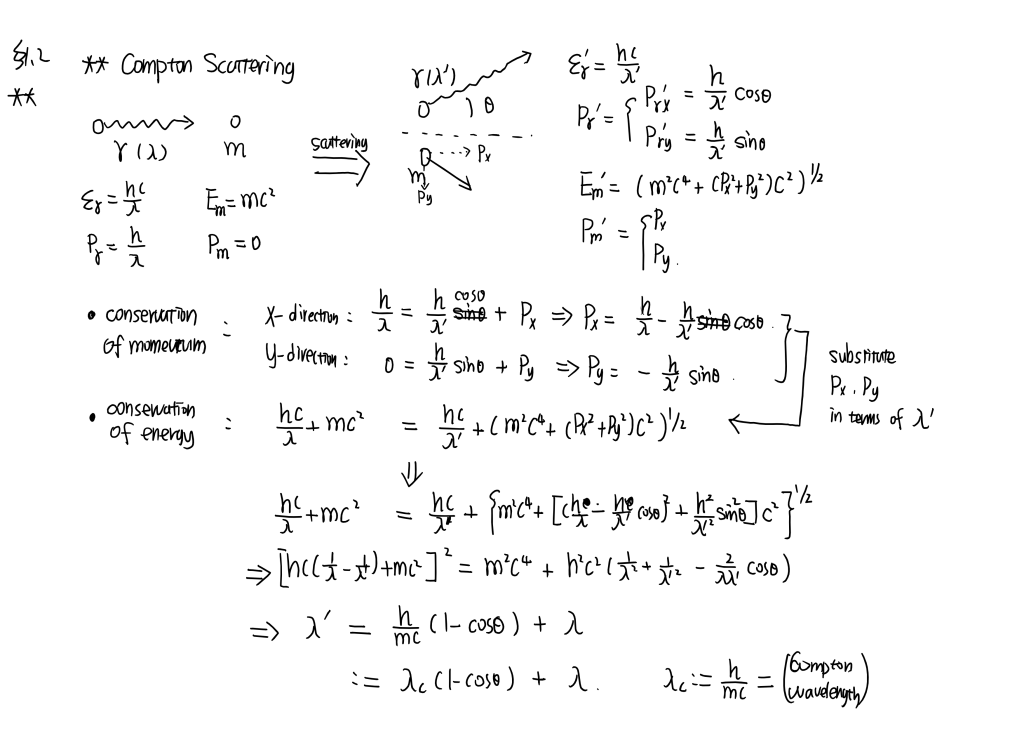
1.2 Photon
solution of Compton scattering may also serve as an exercise of relativity
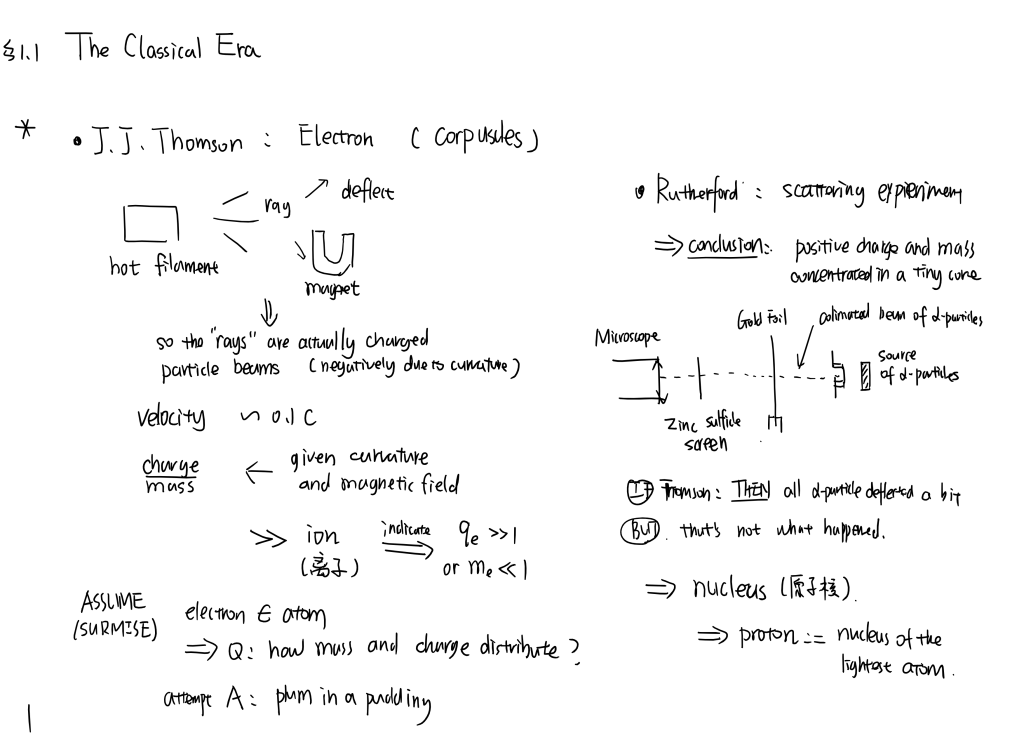
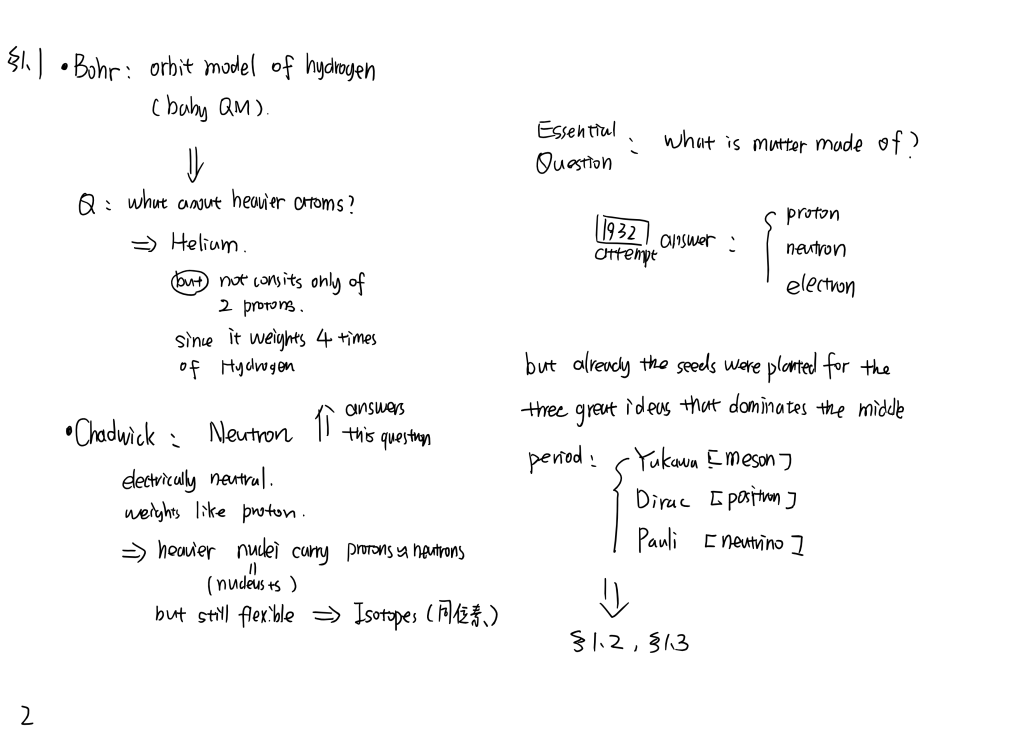
1.1 the Electrical Era
from J. J. Thomson’s discovery of electron to Bohr’s model of hydrogen
本文是格里菲斯大神Introduction to Elementary Particles一书简介部分的笔记
物质是如何构成的
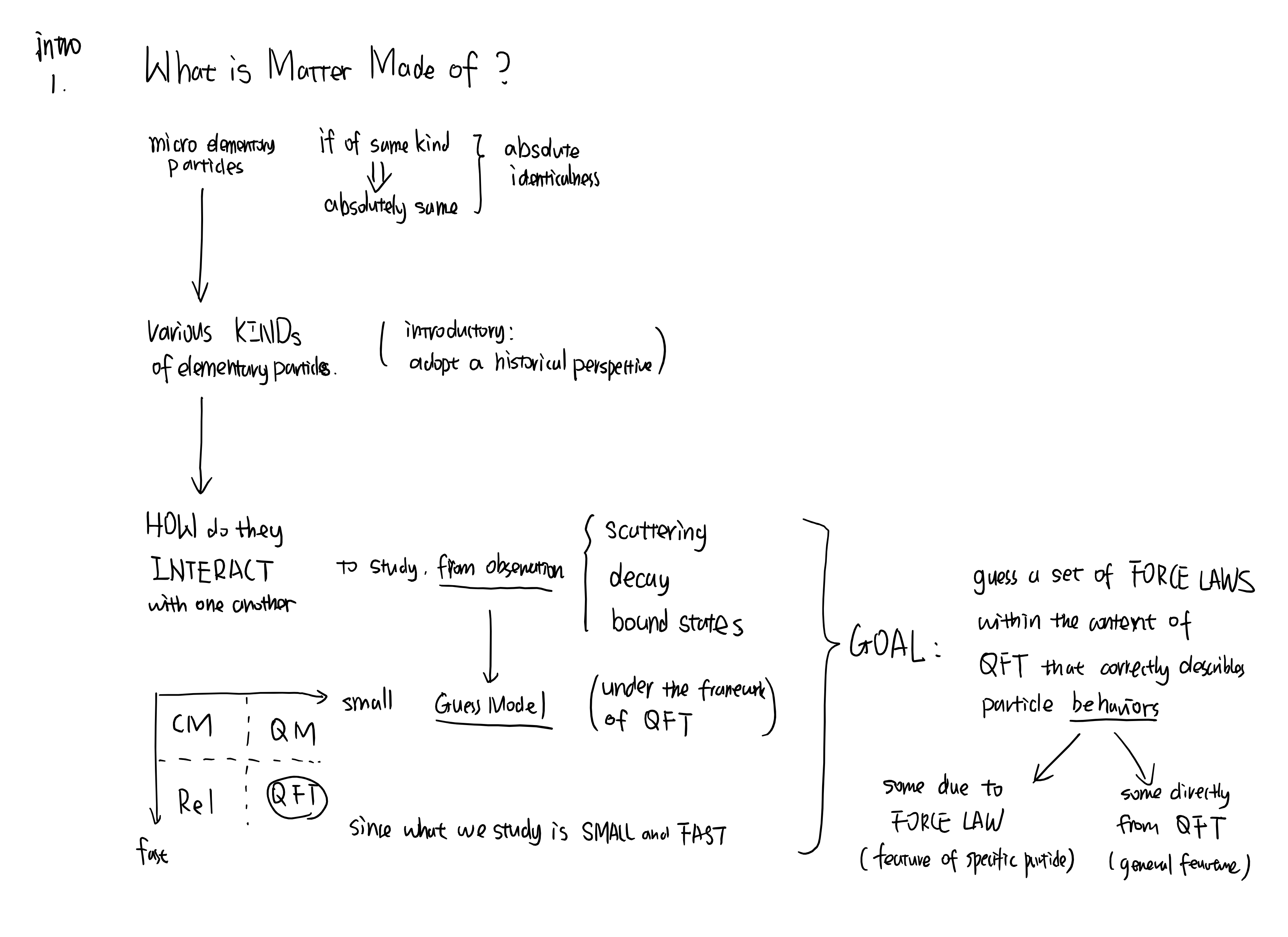
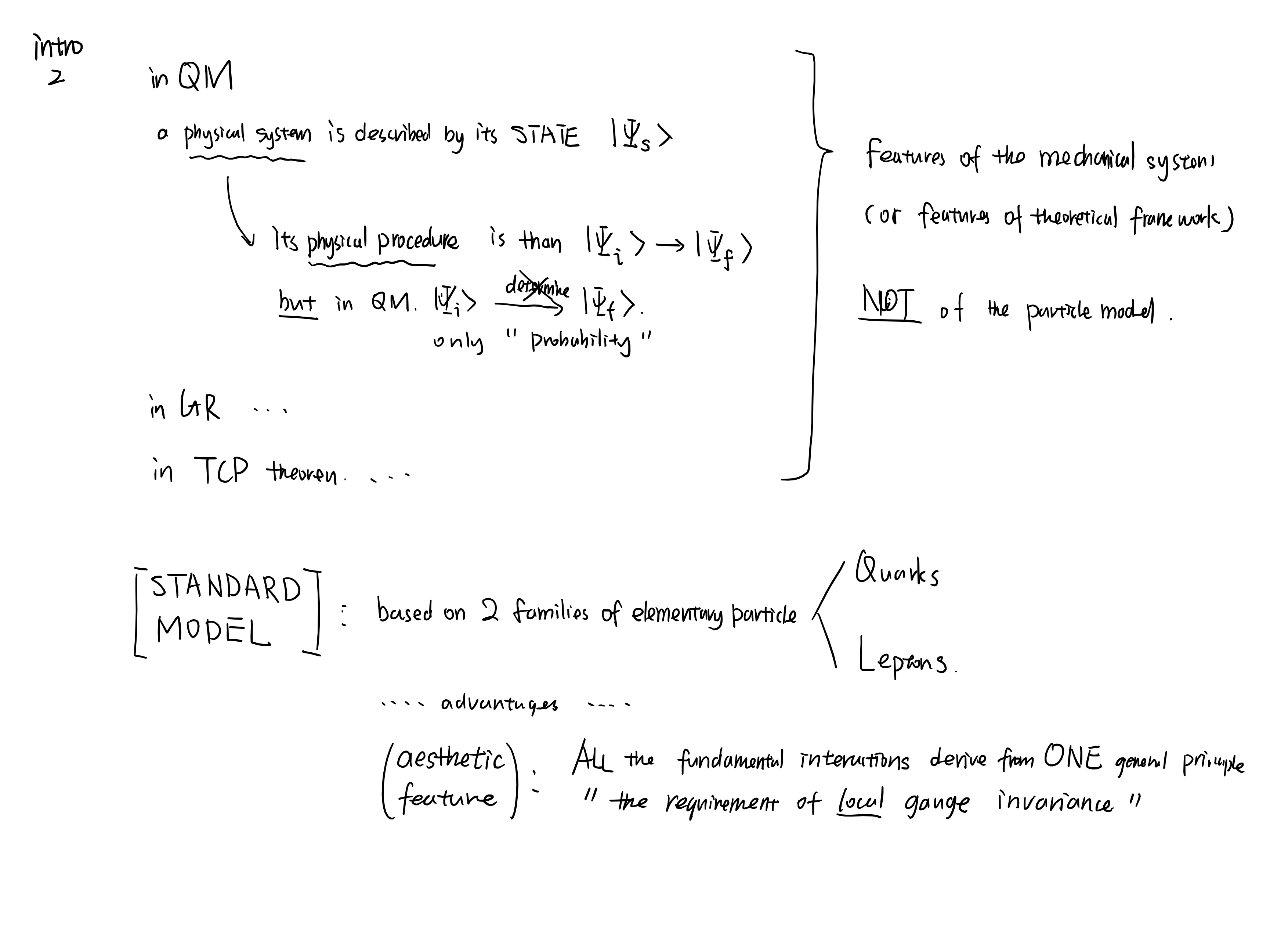
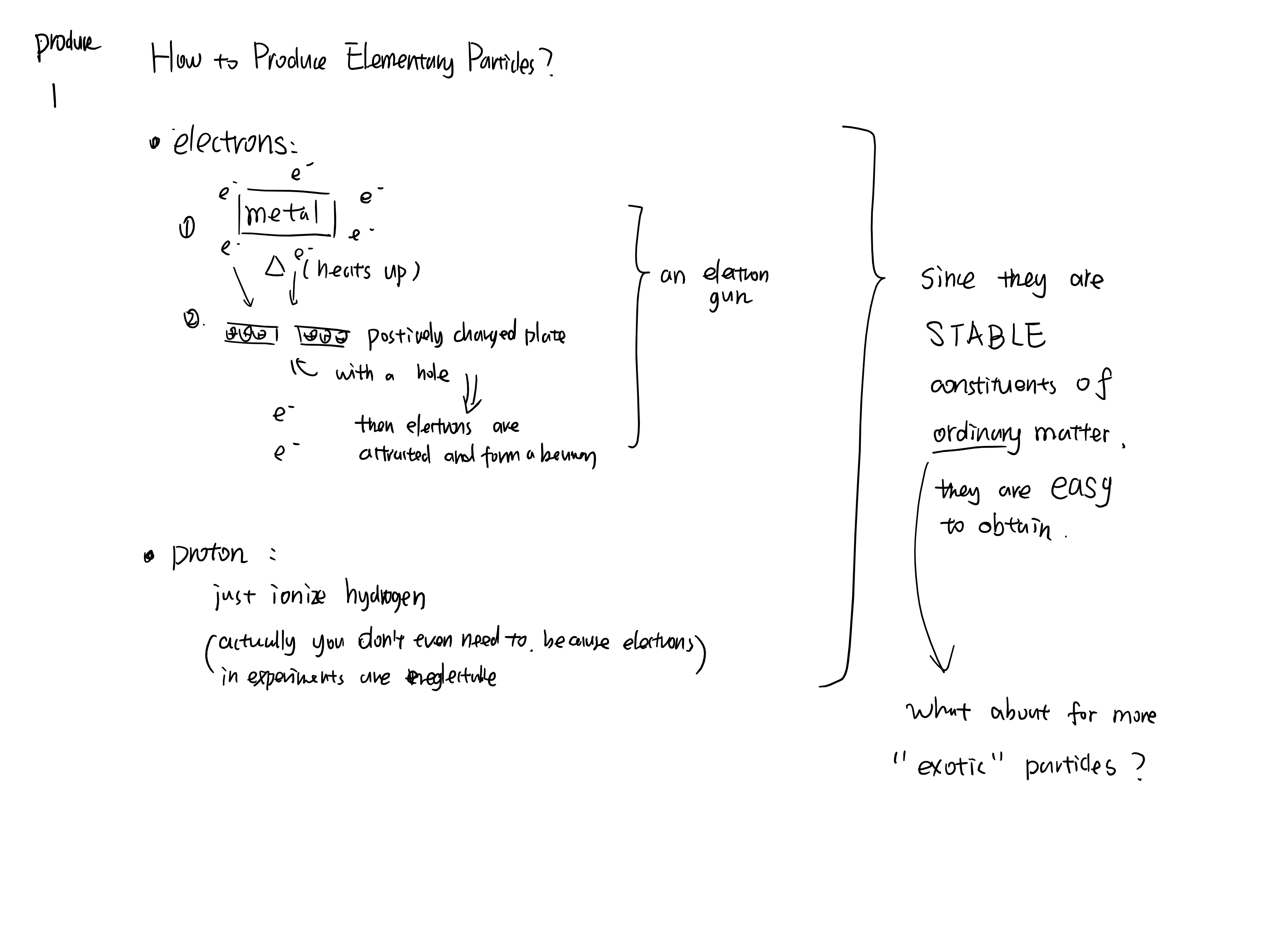
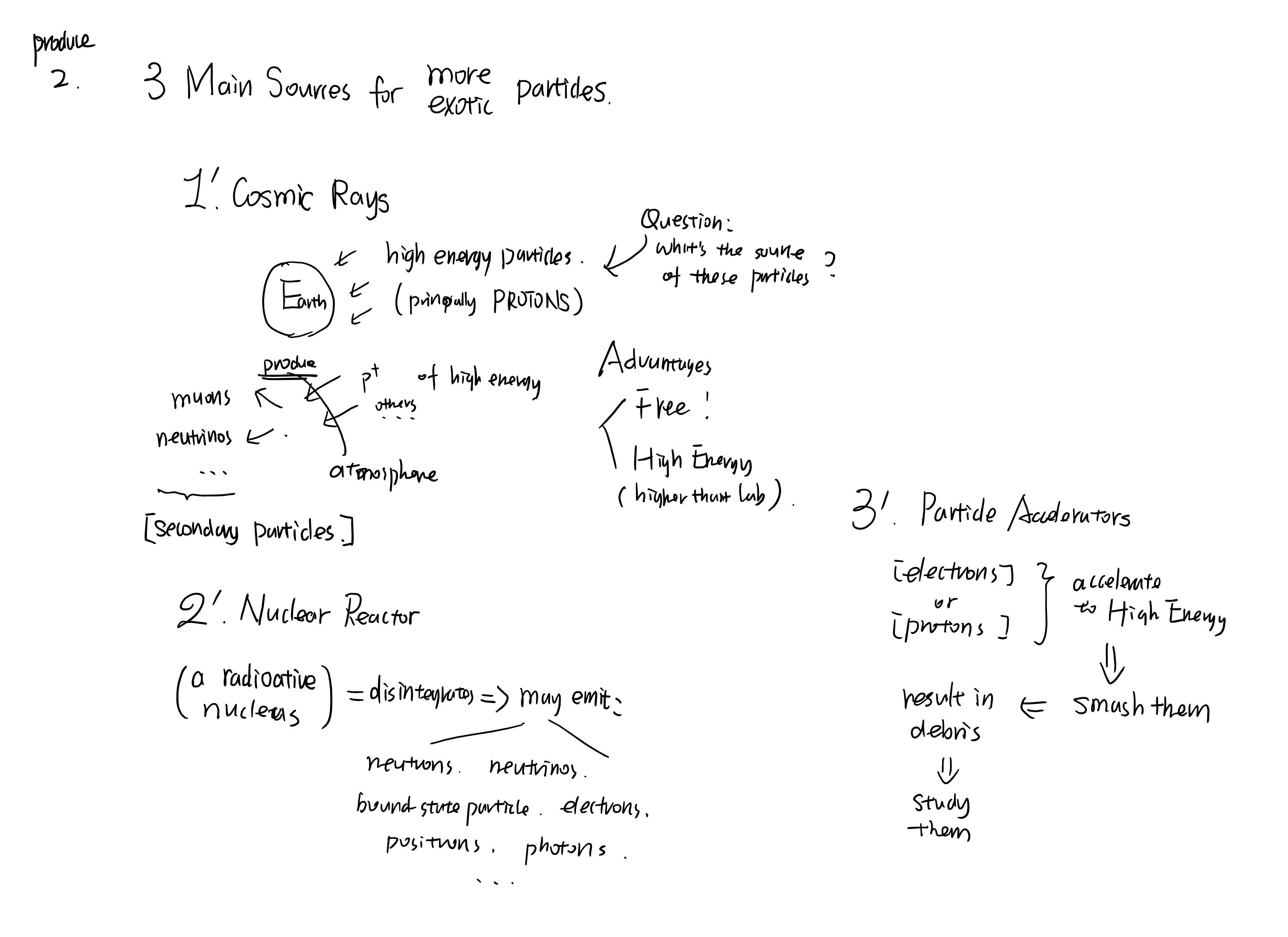
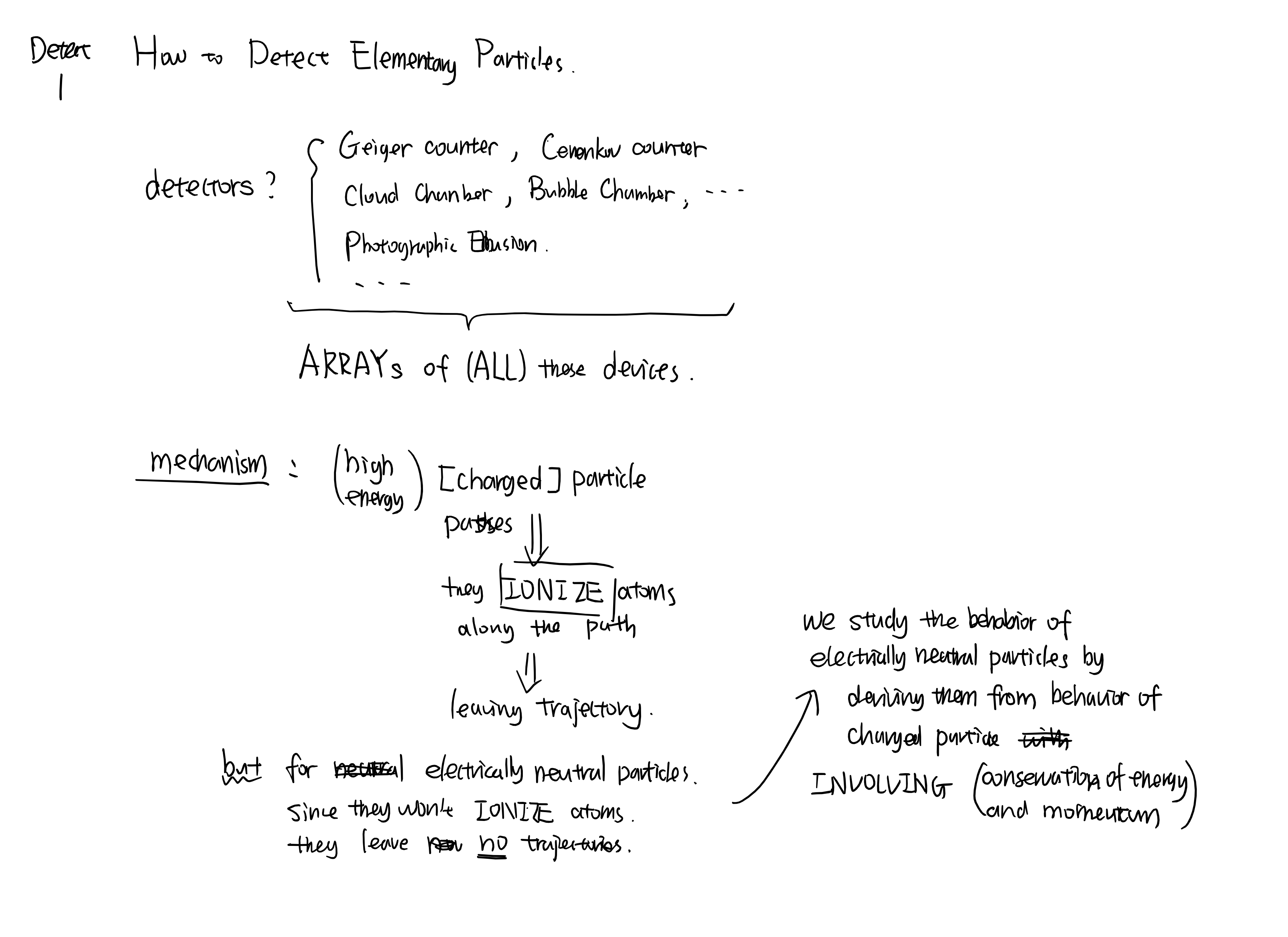
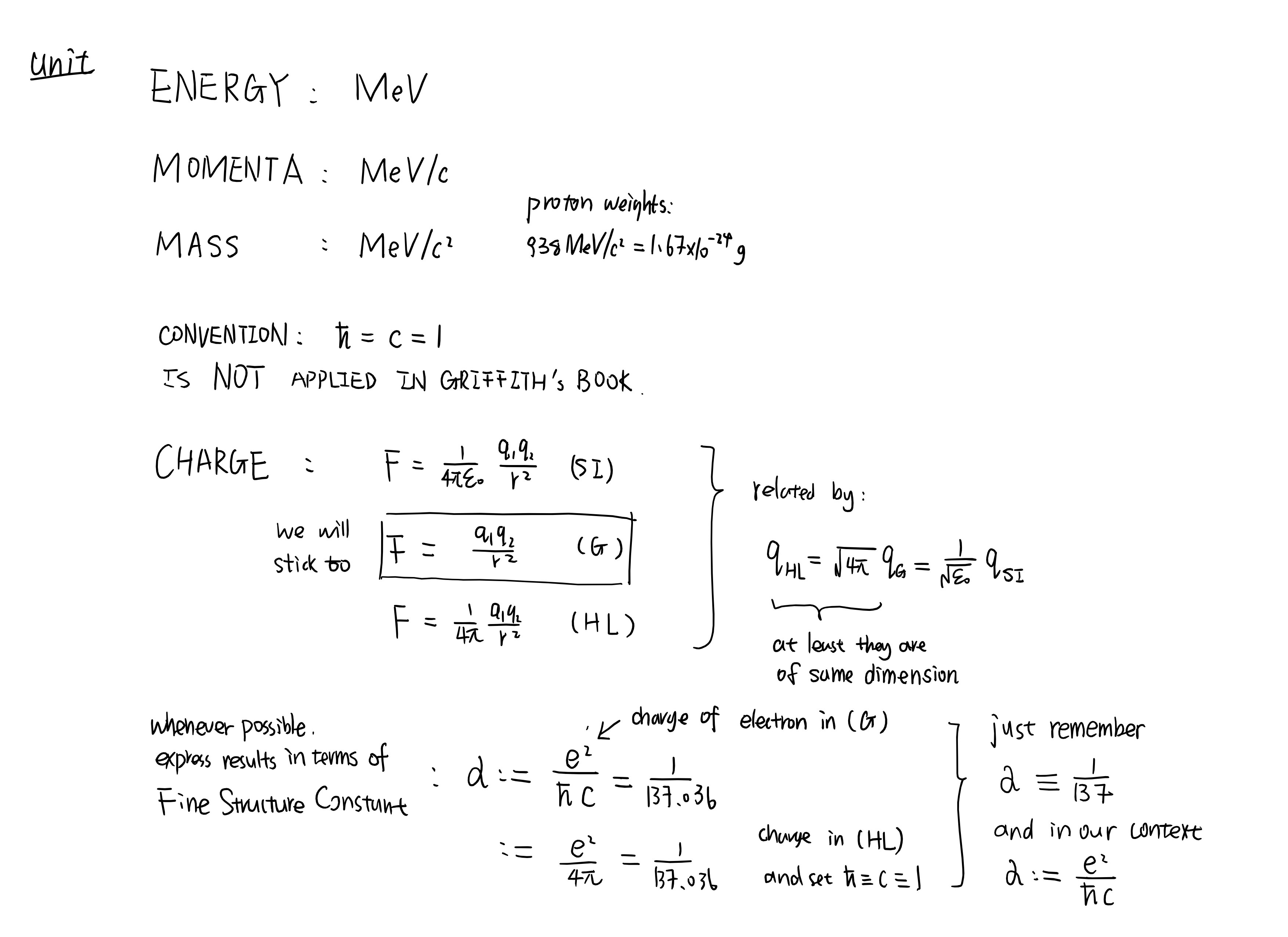
This is an introduction to Griffiths’s classical textbook of Elementary Particles
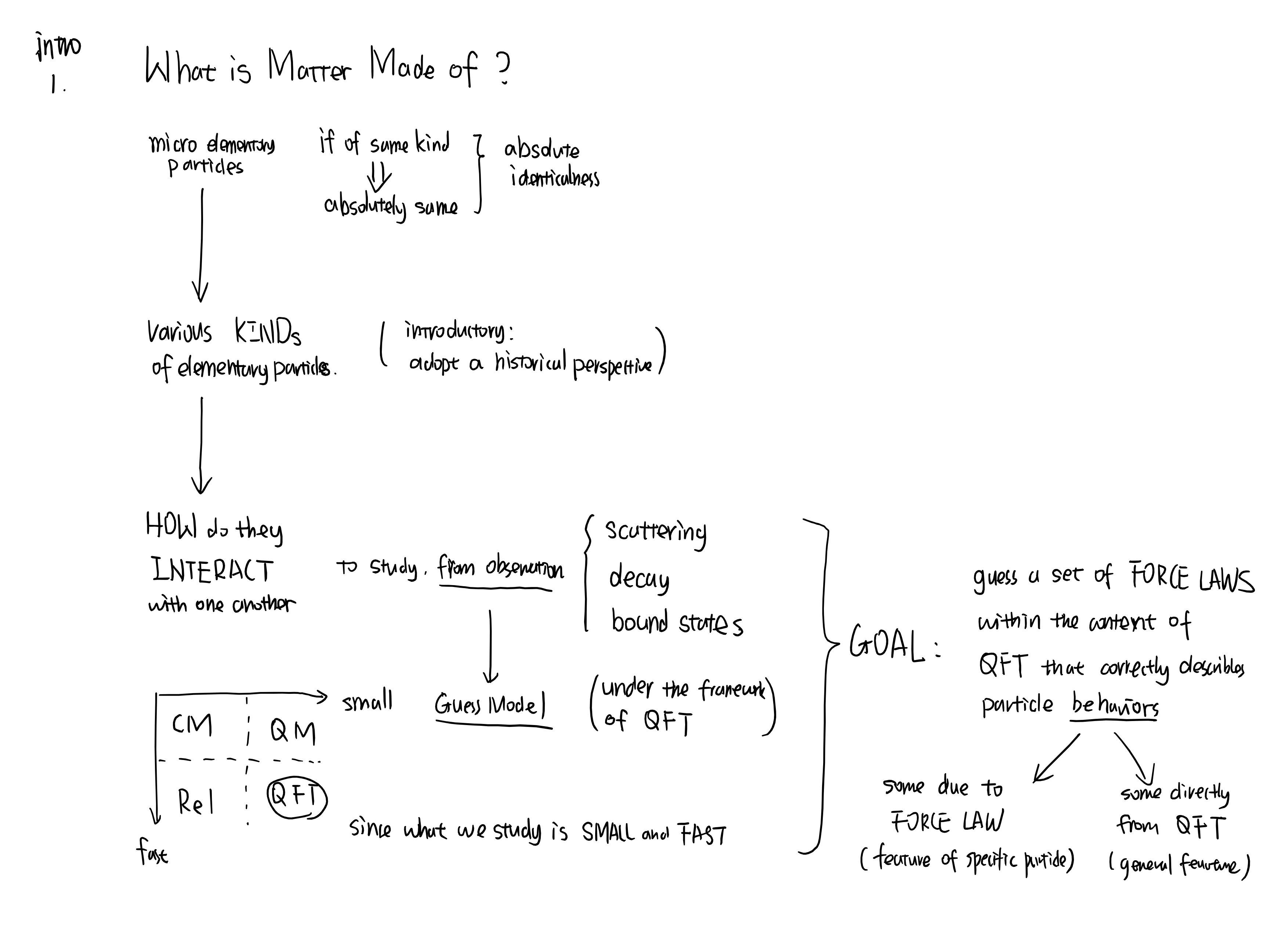
What is matter made of?
本文适合作为张量分析自学入门的一个案例
从牛顿引力和运动学公式出发,利用张量语言推到和描述经典力学框架下的潮汐效应,张量分析的初学者可以此为例联系基本计算和对方向导数的理解,同时作为广义相对论中测地线偏离理论的先导
Newton’s second law (componentwise)
$$
\frac{d^{2} x^{i}}{d t^{2}} \equiv a^{i} \equiv \frac{F^{i}}{m}
$$
Newtonian equation of gravitation
$$
\frac{F^{i}}{m}=-\eta^{i j} \partial_{j} \phi
$$
combine two equations give:
$$
\frac{d^{2} x^{i}}{d t^{2}}=-\eta i j\left[\partial_{j} \phi\right]_{\vec{x}}
$$
where the subscription $\vec{x}$ denotes the derivative is operated at position $\vec{x}$ similarly we have at $\vec{x}+\vec{n}$ :
$$
\frac{d^{2}\left(x^{i}+n^{i}\right)}{d t^{2}}=-\eta^{i j}\left[\partial_{j} \phi\right]_{\vec{x}+\vec{n}}
$$
make subtraction give:
$$
\frac{d^{2} n^{i}}{d t^{2}}=-\eta^{i j}\left(\left[\partial_{j} \phi\right]{\vec{x}+\vec{n}}-\left[\partial{j} \phi\right]_{\vec{x}}\right)
$$
given $\vec{n}$ is infinitesimal, we have RHS:
$$
\text { RHS }=-\eta^{i j} n^{k}\left[\partial_{k}\left(\partial_{j} \phi\right)\right]_{\vec{x}}
$$
set Cartesian coordinates originated from centre of earth orient the $z$-axis so that is consists with $\vec{x}$ (position vector) then $\vec{X}=\left(X^{1}, X^{2}, X^{3}\right)=(0,0, z)$.
gravitational potential is given by:
$$
\phi=-\frac{G M}{r}=-\frac{G M}{\left(x^{2}+y^{2}+z^{2}\right)^{1 / 2}}
$$
and thus
$$
\begin{aligned}
\partial_{j} \phi & =\frac{\partial \phi}{\partial x^{j}} \\
& =-\frac{d \phi}{d r} \frac{\partial r}{\partial x^{j}} \\
& =\frac{G M}{r^{3}} x^{j}
\end{aligned}
$$
and
$$
\begin{aligned}
\partial_{k} \partial_{j} \phi & =\frac{\partial}{\partial x^{k}}\left(\frac{G M}{r^{3}} x^{j}\right) \\
& =\frac{\partial}{\partial x^{k}}\left(\frac{G M}{r^{3}}\right) x^{j}+\delta_{k}^{j} \frac{G M}{r^{3}} \\
& =-\frac{3 G M}{r^{4}} x^{j}+\delta_{k}^{j} \frac{G M}{r^{3}}
\end{aligned}
$$
thus.
$$
\begin{aligned}
& \frac{d^{2}}{d t^{2}} n^{x}=-\frac{G M}{r^{3}} n^{x} \\
& \frac{d^{2}}{d t^{2}} n^{y}=-\frac{G M}{r^{3}} n^{y} \\
& \frac{d^{2}}{d t^{2}} n^{z}=\frac{2 G M}{r^{3}} n^{z}
\end{aligned}
$$